



recommend
Send Us A Message
Why Quaternary Ammonium Compounds Lose Efficacy on Soiled Surfaces
Quaternary ammonium compounds can lose disinfecting efficacy when grease, food residues, body fluids, or other soil remains on a surface. Contamination can bind some of the active ingredient and shield microorganisms from direct contact. A surface may look wet with disinfectant while the organisms beneath a residue receive inadequate exposure.
The practical response is to remove the contamination, then apply the disinfectant at its labeled dilution and wet contact time. Adding extra concentrate does not reliably overcome poor cleaning and can leave excessive residues.
How soil interferes with quat disinfectants
Quaternary ammonium compounds, often called quats or QACs, are positively charged surfactants. Their antimicrobial action involves interacting with microbial membranes and disrupting their function. That action depends on enough available disinfectant reaching susceptible organisms.
Soil interferes in two overlapping ways:
- It reduces available active ingredient. Components of organic residues can bind or adsorb quats, leaving less available to interact with microorganisms. The extent depends on the residue, formulation, and application conditions.
- It creates a physical barrier. Grease films, dried protein, and accumulated deposits can prevent the solution from reaching contaminated areas. Wetting the top of a deposit does not establish effective contact underneath it.
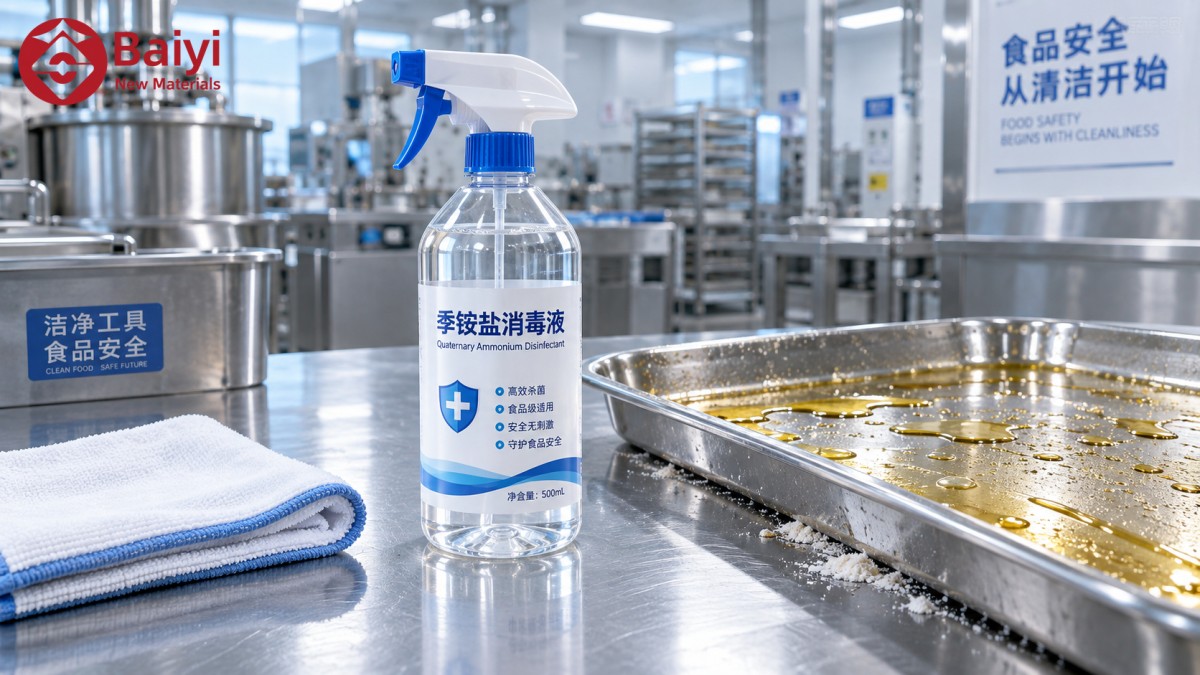
For example, spraying a greasy preparation surface may wet the visible oil film without adequately reaching organisms trapped beneath it. Dried food residue around a joint or handle presents a similar problem: the disinfectant must reach the contaminated surface to work.
Biofilms create an additional challenge. These attached microbial communities sit within a protective matrix that can limit disinfectant penetration. Recurring contamination around seals, drains, or equipment joints may require physical removal of deposits and a sanitation procedure suited to that location.
Cleaning chemicals can also undermine the next step
A surface can be free of visible dirt yet retain a cleaning film. Some anionic surfactants, including those found in certain soaps and detergents, are incompatible with cationic quats. Residues can reduce antimicrobial activity when the products meet.
This does not mean every detergent interferes with every quat formulation. Commercial disinfectant cleaners may contain compatible surfactant systems. The practical distinction is between a formulated product used as directed and separate chemicals mixed or layered without compatibility guidance.
Use a cleaner suitable for the soil and surface, and follow the cleaning and disinfectant instructions for any intervening rinse. Never add detergent or another disinfectant to a quat solution unless the product instructions explicitly permit it.
A reliable sequence for contaminated surfaces
- Remove the bulk soil. Collect loose debris and remove grease or dried deposits using an appropriate cleaner and sufficient wiping or scrubbing. Pay attention to seams, undersides, and textured areas.
- Complete the cleaning step. Remove loosened material and cleaner residue as directed. Avoid carrying dirty cleaning liquid across an already cleaned area.
- Prepare the correct disinfectant dilution. Follow the product instructions for concentration, water conditions, and preparation. Where appropriate, use a test strip intended for that quat formulation and concentration range.
- Apply enough solution for full coverage. Use compatible cloths, mops, or wipes. Some absorbent materials can bind quats and reduce the concentration delivered to the surface.
- Maintain the specified wet contact time. Start timing once the surface is fully wetted. If it dries too soon, follow the label instructions for reapplication so the required wet exposure is achieved.
For food-contact surfaces, follow the product’s specific directions for that use, including any rinse requirement. A disinfectant use dilution and a food-contact sanitizing dilution are not automatically interchangeable.
Does a one-step disinfectant cleaner eliminate precleaning?
Some products are labeled to clean and disinfect in one operation under defined conditions. That can be appropriate for the soil level, surface, and application method covered by the instructions. It does not mean the product can disinfect through any amount of contamination.
Heavy grease, accumulated dirt, and substantial organic deposits generally require removal before disinfection. Check the product’s directions for precleaning and any separate instructions for blood or body-fluid contamination. A claim established under defined soil conditions does not establish performance through thick or dried deposits.
What to check when results remain inconsistent
Check the process in order: soil removal, cleaner compatibility, dilution, application coverage, and wet contact time. A concentration check can help identify a dispensing problem, but it cannot demonstrate that a dirty surface has been disinfected. Likewise, an ATP reading can support a cleaning assessment; it does not directly prove that the target microorganism has been inactivated.
If those conditions are controlled, examine whether the product is suitable for the organism and surface involved. Quats do not have universal antimicrobial coverage, and routine quat disinfectants should not be assumed to control bacterial spores. Persistent contamination may also point to inaccessible deposits, damaged surfaces, or recontamination from cleaning tools.
Before increasing the dose or changing products, establish whether the disinfectant is reaching a properly cleaned surface for the full required contact time. That check often identifies the condition that needs correction.