



recommend



Send Us A Message
Using Amino Acids in Broiler Feed to Reduce Crude Protein and Maintain Growth
Broiler diets can contain less crude protein and still maintain growth when they supply enough digestible amino acids, usable energy, and nitrogen for tissue development. The practical limit depends on the starting formulation, ingredient quality, growth phase, and production conditions. Matching a few essential amino acid targets does not guarantee that a lower-protein diet will preserve feed conversion or breast meat yield.
For technical evaluation, the useful question is how much protein can be removed from a particular diet before another nutritional constraint appears. A staged reduction, supported by formulation checks and controlled feeding comparisons, provides a stronger basis for decisions than adopting a universal minimum crude protein level.
Formulate around digestible amino acid supply. Reducing soybean meal or another protein ingredient changes the entire amino acid profile. Supplemental methionine, lysine, and threonine may address the first constraints, but further reductions can make valine, isoleucine, arginine, tryptophan, or other amino acids limiting. Their order depends on the ingredients and the bird’s requirements.
Use a consistent standardized ileal digestible basis for both ingredient values and nutrient specifications. Total amino acid concentrations alone can hide differences in availability caused by ingredient composition or processing. Establish an appropriate digestible lysine target for each feeding phase, then assess the other essential amino acids relative to that target and their absolute dietary concentrations. Ratios can appear satisfactory while the whole diet remains undersupplied.
Starter, grower, and finisher diets need separate assessments. Young birds have different nutrient demands and feed intake capacity, so a reduction that works later in production may be unsuitable early on. Requirements also need to reflect the broiler strain, expected intake, and performance objective.
As intact protein falls, the supply of amino acids that birds can synthesize also deserves attention. Glycine and serine availability, together with sufficient nitrogen for synthesis of other nonessential amino acids, can constrain performance in more extensively reduced-protein diets. Adding more lysine or methionine will not correct that shortage.
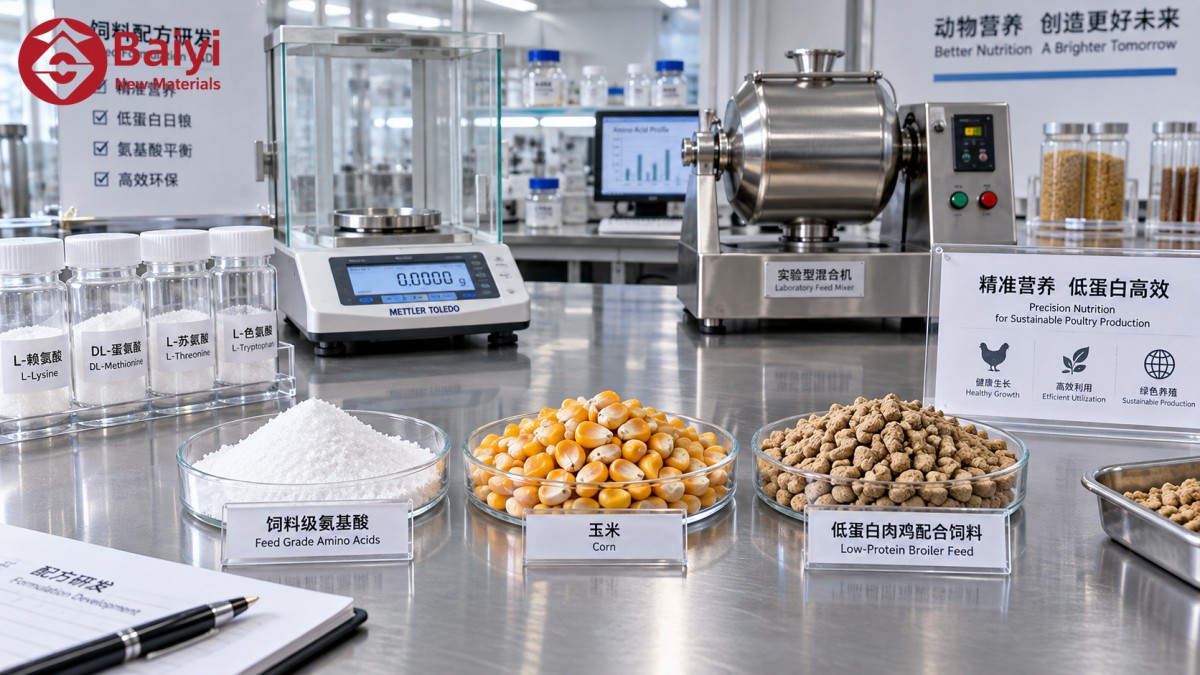
Rebalance the diet after removing protein ingredients. Replacing protein meals with cereals and supplemental amino acids changes more than the protein figure on the formulation sheet. Starch, fiber, fat, minerals, and dietary electrolyte balance can all shift. These changes help explain why two diets with similar essential amino acid specifications can produce different results.
Energy must be assessed alongside amino acid supply. If birds receive more usable energy than their capacity for lean tissue deposition requires, a diet may maintain live weight while increasing fat deposition. Feed intake can also change, altering daily amino acid intake even when the concentration per kilogram appears adequate. Evaluate weight gain, feed conversion, and carcass characteristics together.
Review potassium, sodium, chloride, and choline after changing ingredient inclusion rates. Account for nutrients and counterions contributed by the selected amino acid products. A lysine hydrochloride product, for example, contributes chloride as well as lysine; alternative product forms require their own formulation values. Consistency in the energy system and ingredient matrix is essential when comparing candidate diets.
Check the amino acid product and its delivery through the feed process. Feed-grade amino acids should enter the formulation at their declared active nutrient contribution, with appropriate allowances for product form and moisture. Product weight and active amino acid weight are not interchangeable. Methionine sources also require source-specific nutritional matrix values rather than automatic substitution on an equal-weight basis.
Technical qualification should cover identity, assay, moisture, relevant impurities, and compliance with applicable feed requirements. A batch certificate supports this assessment, while a sampling and verification program helps establish whether delivered material consistently meets the specification.
Physical handling matters because low inclusion rates make dosing and mixing errors consequential. Check particle characteristics, flowability, segregation risk, and compatibility with the premixing process. Confirm that storage and feed manufacturing conditions are suitable for the selected product. Accurate formulation cannot compensate for uneven distribution in the finished feed.
Validate the reduction against a defined performance threshold. Compare a nutritionally adequate control with progressively reduced-protein diets under otherwise comparable conditions. Use replicated groups and enough birds to distinguish a meaningful performance difference from normal variation. Record actual feed composition where practical, because a trial cannot establish the value of a formulation that the manufactured feed did not deliver.
- Track body weight gain, feed intake, mortality, and mortality-adjusted feed conversion by feeding phase.
- Measure breast yield and abdominal fat when processing value influences the commercial decision.
- Assess litter condition and water use alongside performance; neither alone proves that nitrogen excretion has fallen.
- Compare feed cost per unit of saleable output, including the cost of additional amino acids and any change in yield.
Define an acceptable performance margin before interpreting the results. A small feed-cost saving can disappear if feed conversion deteriorates or breast yield declines. Conversely, an equal-cost formulation may still be useful where reducing nitrogen output has operational value. Lower nitrogen intake can reduce excretion when nitrogen retention is maintained, but quantifying that benefit requires an appropriate nitrogen balance assessment.
The practical stopping point is the lowest protein level that repeatedly meets the operation’s growth, carcass, and economic requirements. If performance weakens after the next reduction, examine daily digestible amino acid intake, glycine and serine supply, energy balance, and feed delivery before increasing supplements indiscriminately. Retaining some intact protein may be the more reliable formulation choice when several constraints emerge together.