



recommend

Send Us A Message
What Do Industrial Surfactants Do in Metal Cleaning and Degreasing?
Industrial surfactants help water-based metal cleaners reach, loosen, and carry away oil and grease that water alone cannot remove effectively. They improve contact between the cleaning solution and an oily surface, help detach contamination, and keep removed material from immediately settling back onto the metal.
They are not complete cleaning systems by themselves. Performance depends on how the surfactant works with the cleaner’s other ingredients, the metal being cleaned, and the washing and rinsing conditions. A formulation that removes machining oil well in an immersion tank may create excessive foam in a spray washer or leave residues that interfere with coating adhesion.
How surfactants help separate oil from metal
Water tends to bead on oily metal because it does not readily spread across the contamination. Surfactant molecules contain both water-attracting and oil-attracting portions. By concentrating at interfaces between water, oil, and the metal surface, they reduce surface and interfacial tension, helping the cleaning liquid spread and penetrate around deposits.
This creates several related cleaning actions:
- Wetting: The solution reaches more of the contaminated surface, including recesses and areas around machining marks.
- Oil release: Changes at the oil–water–metal interface help oily films retract and detach. Heat, spray pressure, agitation, or ultrasonic energy can assist this process.
- Emulsification and solubilization: Detached oil can be distributed as droplets, while some oily components can be incorporated into surfactant aggregates called micelles.
- Reduced redeposition: Surfactants, often working with dispersants and other additives, help keep removed contamination from returning to the parts.
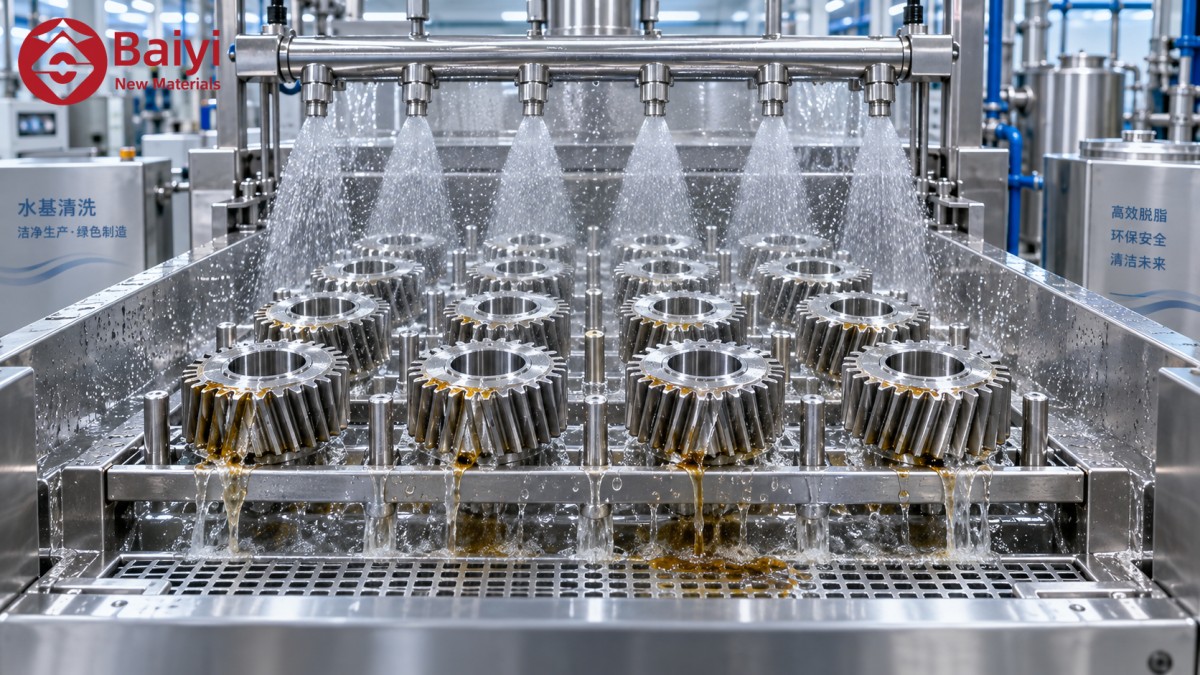
These actions do not mean that a surfactant chemically destroys every contaminant. Mineral oils mainly require physical removal and management within the bath. Some fatty oils can also react with alkaline ingredients through saponification, forming soaps. Rust, oxide scale, and mineral deposits require different cleaning chemistry; surfactants may improve access but do not replace the ingredients responsible for removing them.
Why surfactant type matters
The electrical character of a surfactant’s water-attracting group influences its behavior. Metal-cleaning formulations frequently combine types because wetting, oil removal, foam control, and rinsing are not always optimized by the same ingredient.
These categories are starting points, not performance guarantees. Two nonionic surfactants can differ substantially in foam generation, oil affinity, temperature response, and rinseability.
Stronger emulsification is not always better
A stable emulsion can keep removed oil distributed through a cleaning bath, reducing immediate redeposition. However, it can also make that oil difficult to remove with a skimmer or gravity separator. As contamination accumulates, bath performance and downstream wastewater treatment can become harder to manage.
Where cleaning equipment includes oil separation, a formulation designed to release oil after removal may be preferable to one that holds it in a persistent emulsion. The useful distinction is between removing oil from the part and keeping oil permanently mixed into the bath. These are separate requirements, and maximizing the second does not necessarily improve the first.
Process conditions determine whether cleaning succeeds
Foam must match the equipment. Spray washers introduce air and mechanical energy, so a surfactant that performs acceptably in a still beaker may foam excessively in operation. Foam can disrupt pumping, reduce effective spray action, and cause overflow. Visible foam is not a reliable measure of cleaning strength.
Temperature changes more than cleaning speed. Heating can reduce oil viscosity and assist removal, but it also changes surfactant solubility and foam behavior. For cloud-point nonionics, operation near or above the cloud point may be intentional, but only within a formulation designed for those conditions.
Metal compatibility belongs to the whole formulation. Aluminum and zinc can be attacked by strongly alkaline cleaners, while freshly cleaned steel may flash-rust without suitable process control. Choosing a surfactant does not remove the need to evaluate pH, inhibitors, exposure time, and rinsing.
Rinsing is part of cleaning, not an afterthought. Residual surfactant or cleaner salts can interfere with painting, bonding, or plating. A water-break-free surface—a continuous water film rather than isolated beads—can indicate improved cleanliness, but it does not prove that every harmful residue has been removed.
The practical measure of a surfactant is therefore not how much foam it produces or how aggressively it emulsifies oil. It is whether the complete cleaning process consistently delivers a compatible, sufficiently clean, readily rinsed metal surface for the next operation.