



For procurement teams, the better Sodium Hydroxide purchase is the form with the lowest total cost per tonne of usable NaOH at the plant.
Flakes can reduce freight costs by limiting shipped water, while a 50% solution can simplify dosing where suitable bulk storage and transfer systems already exist.
The decision depends on delivered pricing, actual concentration, dissolution costs, temperature control, and consumption. Comparing these factors together reveals whether an apparent discount survives plant handling.
What Does Each Delivered Tonne Actually Buy?
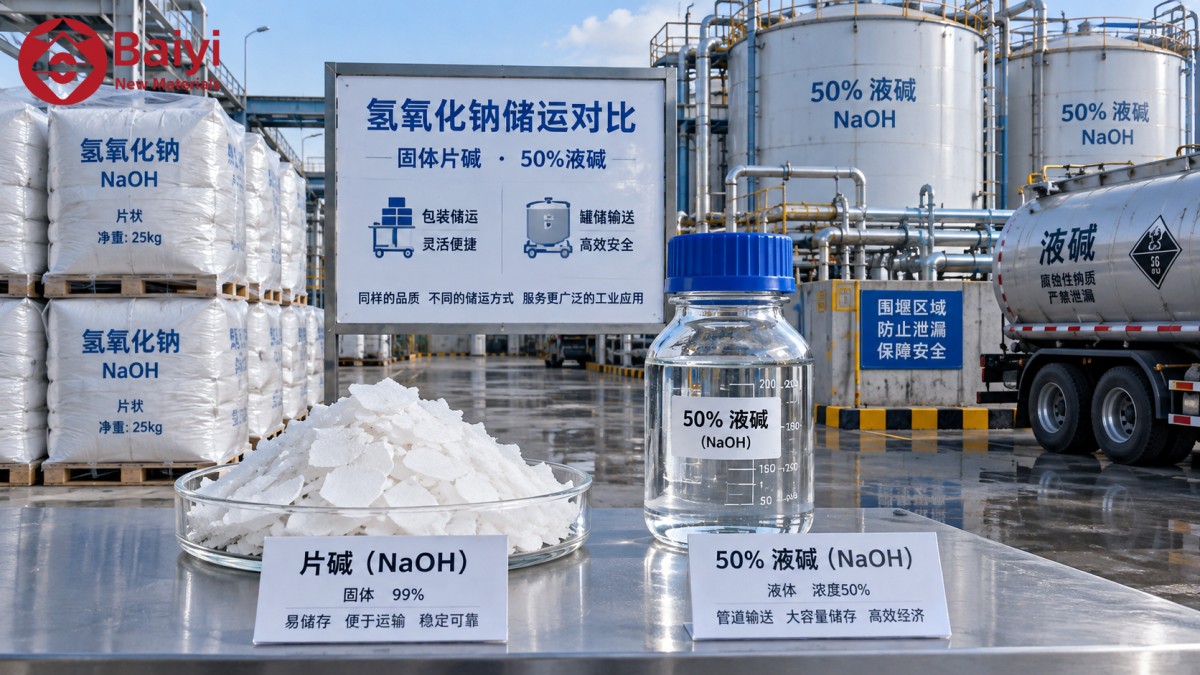
Start by converting every quotation to an active NaOH basis. A tonne of 99% flakes contains approximately 0.99 tonnes of NaOH; 50% solution contains 0.50 tonnes.
Divide the delivered price per product tonne by the NaOH mass fraction. Use the quoted specification initially, then confirm concentration through agreed testing and documentation.
The following figures are illustrative, not market quotations. They assume comparable delivery boundaries and exclude plant handling, taxes, financing, and any separately charged packaging costs.
Here, flakes save only US$22.22 per active tonne before handling. If their additional dissolution and handling costs exceed that difference, the solution becomes more economical.
When Does Shipping Less Water Produce Real Savings?
Supplying one tonne of active NaOH requires approximately 1.01 tonnes of 99% flakes or 2.00 tonnes of 50% solution, before accounting for packaging and losses.
This mass advantage often favors flakes over long distances. However, freight invoices also reflect shipment size, equipment availability, route restrictions, packaging, and destination handling charges.
Compare quotations at the same Incoterm and named location. Add inland transport, terminal charges, customs costs, unloading, and container or tanker detention where applicable locally.
A nearby bulk solution supplier may remain competitive despite shipping more water. Frequent deliveries can also reduce inventory carrying costs when supply reliability supports smaller stocks.
Which Handling Costs Can Reverse the Price Advantage?
Flakes require dry storage, package handling, and controlled dissolution when the process uses liquid caustic. Include labor, water, energy, equipment maintenance, and packaging disposal costs.
Dissolving Sodium Hydroxide releases substantial heat. A suitable system needs controlled solids addition to water, agitation, and temperature management under an approved operating procedure for safety.
For bulk solution, assess compatible tanks, pumps, piping, unloading connections, and secondary containment. Existing equipment can make liquid purchasing attractive; new infrastructure changes the calculation.
Cold conditions can cause 50% caustic soda to crystallize, typically around 12°C. Confirm supplier guidance and assess insulation or heating requirements against local minimum temperatures.
Both forms require compatible materials, worker protection, and emergency facilities. Evaluate these costs for the actual transfer method, rather than assuming either form eliminates exposure risks.
Does Your Consumption Pattern Favor Flakes or Solution?
Steady, high consumption often favors bulk solution when storage and dosing systems already exist. Automated transfer can reduce manual handling and support consistent process feeding.
Flakes may suit smaller, intermittent demand or locations with expensive liquid freight. Their advantage depends on dry storage capacity and the ability to prepare solution efficiently.
Compare storage requirements using usable NaOH capacity, allowing for packaging, access, tank working volume, and operational reserve. Equal product tonnage does not provide equal chemical inventory.
Check application specifications before comparing prices alone. Carbonate, chloride, iron, and other impurity limits may affect suitability, especially where process performance requires tighter quality control.
What Should Procurement Request Before Awarding the Order?
Request concentration, impurity limits, packaging or bulk delivery details, minimum order quantity, lead time, and quotation validity. Confirm the named delivery point and unloading responsibilities.
Ask for a certificate of analysis, safety data sheet, and agreed acceptance criteria. For solution deliveries, establish whether invoicing follows actual concentration or nominal product weight.
Build an annual comparison using forecast active NaOH consumption. Include delivered material, handling, utilities, maintenance, inventory financing, losses, and annualized equipment investment where required for operation.
Choose the Lowest Total Cost Your Plant Can Sustain
Choose flakes when freight savings exceed the added cost of dissolution and package handling. Choose 50% solution when transfer efficiency and existing infrastructure outweigh transporting water.
Shandong Carbon Steel Metal Products Co., Ltd., founded in 2008, supplies chemical raw materials internationally. Buyers can request quotations specifying concentration, delivery terms, and documentation requirements.
The strongest purchasing decision combines equivalent active NaOH pricing with realistic plant costs. Recheck that comparison whenever freight rates, consumption, seasonal temperatures, or infrastructure change materially.