



Send Us A Message
Why Polyacrylamide Forms Lumps During Mixing—and How to Prevent Them
To prevent polyacrylamide lumps, introduce the dry powder gradually into a well-circulating water stream, keep newly added particles separated, and allow enough time for hydration before dosing. Increasing mixer speed after lumps appear rarely corrects the original problem. Once a gel layer surrounds a cluster of powder, water reaches its interior slowly, leaving a dry core inside an apparently wet mass.
These clumps, often called “fish eyes,” reduce the amount of fully dissolved polymer available for treatment. They also collect on strainers, restrict dosing lines, and make solution strength inconsistent. The most useful adjustments happen where powder first contacts water: feed rate, wetting pattern, local circulation, and starting solution concentration.
Read the lump before changing the mixing conditions
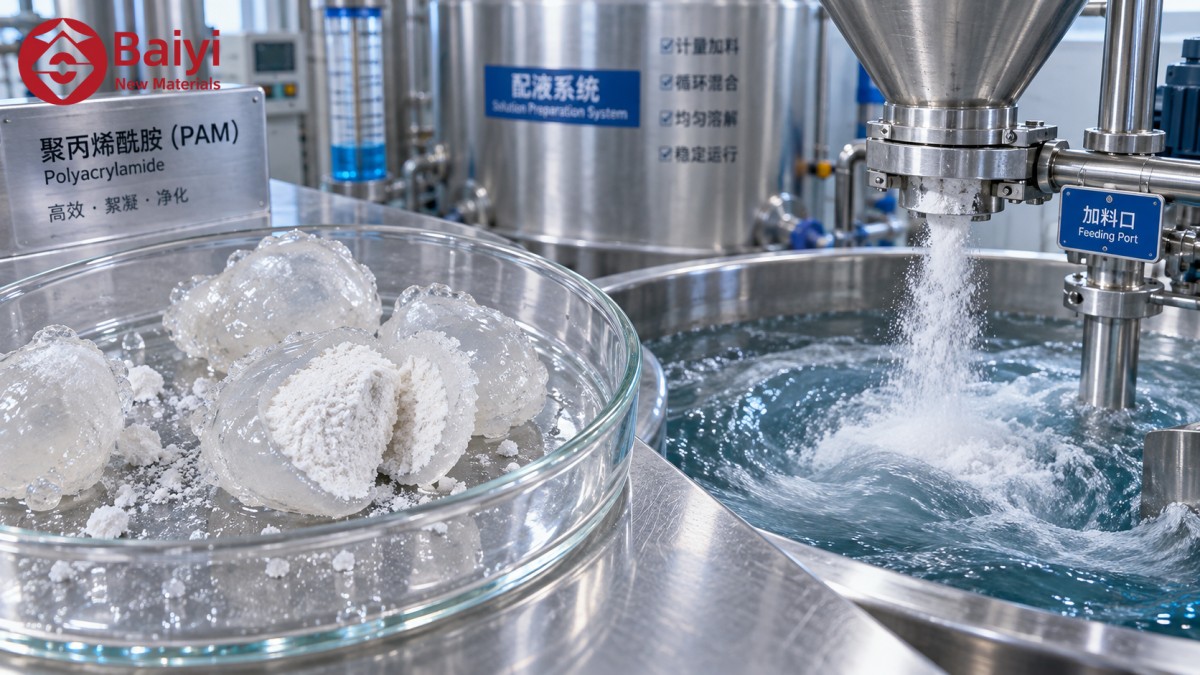
A translucent, slippery shell surrounding a white or powdery center points to poor initial dispersion. The outer particles hydrated together and formed a barrier around the rest. A large clump can remain intact even while the surrounding solution looks uniform.
Inspect a removed sample with a suitable utensil while wearing the protective equipment specified in the safety data sheet. Avoid handling wet polymer directly; spilled solution also creates an extremely slippery surface. The internal appearance helps distinguish a wetting failure from other preparation problems.
Cloudiness alone does not establish that dissolution has failed. Entrained air and the characteristics of the grade can affect appearance. Visible dry cores, persistent gel particles, and uneven samples provide stronger evidence than clarity by itself.
The first contact with water determines whether particles separate
Dry PAM particles begin swelling as soon as water reaches their surfaces. When individual particles remain separated, water can continue entering each particle. When powder lands in a pile, the outer surfaces become sticky and bind neighboring particles together before the interior receives enough water.
This explains why pouring a bag quickly into a tank creates problems even when the tank contains plenty of water. The relevant condition is the amount of moving water available at the point of addition. A large tank with weak surface circulation can have less effective wetting capacity than a smaller vessel with a properly arranged dispersion zone.
Add powder as a controlled, distributed stream. A dense rope of powder falling from a feeder encourages agglomeration. Position the outlet where fresh water continuously carries particles away, without letting powder strike a wet wall, mixer shaft, or tank fitting. Material stuck to these surfaces can hydrate into a mass and later fall into the batch.
A deep vortex is not a reliable sign of good dispersion. Powder drawn into an air-filled funnel can collect at its edges, while air entrainment causes foam and complicates level readings. Aim for effective surface turnover and circulation through the tank. The required mixer setting follows from vessel geometry, impeller arrangement, liquid level, and viscosity; rpm alone cannot describe it.
Match powder addition to the changing batch
As dissolved polymer accumulates, the solution becomes more viscous and circulates differently. A feed rate that works at the beginning can overwhelm the wetting zone near the end. Watch whether fresh powder disappears into moving liquid or starts forming a floating mat. Persistent surface accumulation is a reason to pause addition and restore dispersion.
Prepare the solution at a concentration supported by the specific grade and available equipment. A more concentrated stock reduces the amount of water needed in the preparation tank, but it also makes wetting, circulation, and transfer harder. High molecular weight grades are particularly sensitive to this tradeoff because viscosity develops strongly during hydration.
Calculate concentration using the intended final batch mass and the stated basis, including whether the instruction refers to supplied product or active polymer. Confusing these bases produces a different solution from the one expected. Adding extra powder to compensate for weak treatment performance can then make an existing dissolution problem worse.
For batch preparation, establish water circulation before introducing powder. Starting with powder in an empty vessel and adding water over it creates a wet outer layer around a compact bed. Follow the equipment’s fill sequence, maintaining enough liquid to cover the impeller and support circulation throughout addition.
Dry powder and inverse-emulsion products require different preparation arrangements. An emulsion depends on effective inversion under its specified dilution conditions; its preparation instructions should not be substituted for a dry-powder procedure.
Use mixing intensity where it helps
Initial wetting needs enough local movement to separate incoming particles. After dispersion, the task changes to maintaining circulation while hydration proceeds. Continuing aggressive mixing throughout the entire preparation period exposes dissolved chains to unnecessary mechanical stress.
High molecular weight PAM can lose performance when subjected to excessive shear. The effect depends on the grade, equipment, exposure time, and flow conditions. High-speed mixers, restrictive recirculation paths, and repeated passage through unsuitable pumps deserve attention when a solution appears dissolved but performs poorly.
Increasing speed to break existing fish eyes creates a difficult compromise: the lump interior remains protected while already dissolved polymer experiences more shear. A dedicated powder wetting device is useful because it concentrates dispersion energy at initial contact. Its water flow, powder feed, and discharge path must remain matched; a blocked outlet or insufficient wetting flow defeats that function.
Inspect circulation beyond the visible surface. Gel can accumulate behind baffles, near the tank bottom, or in poorly swept corners. If the upper sample looks uniform but the outlet repeatedly plugs, investigate these areas and the transfer arrangement before assuming the preparation time is too short.
Water quality changes the preparation window
Cold water slows hydration and lengthens the time needed before dosing. Warmer water can accelerate dissolution within the grade’s recommended range, but excessive heating should not be used as a general remedy. Faster surface hydration can also make poor powder dispersion less forgiving.
Dissolved salts affect polymer chain expansion, solution viscosity, and dissolution behavior. Hardness and conductivity are useful diagnostic measurements, especially when preparation changes after a water-source switch. A lower viscosity reading in saltier water does not automatically mean that less polymer was added or that the chains were damaged.
Use a small comparison batch to separate water effects from equipment effects. Prepare the same grade at the same concentration in the current make-up water and in a suitable clean reference water, keeping temperature and mixing conditions comparable. A clear difference narrows the investigation without requiring immediate changes to the full-scale process.
Process recycle water deserves particular scrutiny. Suspended solids, residual treatment chemicals, oil, or oppositely charged materials can interfere with preparation. For example, contact between an anionic polymer and a concentrated cationic chemical can produce aggregates that resemble undissolved material. Keep concentrated chemical streams separate and assess their compatibility at the intended point of use.
Do not add acid, alkali, salt, or another chemical simply to force lumps to dissolve. Such additions change the preparation chemistry and can affect polymer stability or downstream treatment. Adjust water chemistry only within the grade’s documented preparation requirements.
Give hydration a defined place in the process
The end of powder addition is not the end of preparation. Particles that have dispersed successfully still need time to hydrate and develop the intended solution properties. Use the recommended maturation period as the starting point, then confirm that the actual water temperature, concentration, and mixing arrangement support it.
In a batch tank, distinguish the addition period from the subsequent hydration period. In a continuous preparation system, prevent freshly wetted material from moving directly to the dosing outlet. Nominal tank volume divided by flow rate does not guarantee adequate residence time when short-circuiting occurs.
Assess readiness using representative samples and a consistent method. Observe persistent gel, compare samples from relevant locations, and measure viscosity only under defined conditions. Temperature, concentration, instrument settings, and water composition all influence the result. A viscosity value taken under different conditions is a weak basis for accepting or rejecting a batch.
Allowing more time is appropriate when well-dispersed particles are still hydrating. It is less effective when large dry cores are sealed inside dense gel. Extending storage indefinitely also introduces separate concerns about solution stability, so remain within the grade’s recommended holding conditions.
When a batch already contains lumps
Stop powder addition first. Continuing to feed into a failing wetting zone increases the amount of poorly dispersed material and makes recovery harder. Maintain suitable circulation, identify whether the problem is local accumulation or widespread fish-eye formation, and take a representative sample.
For a batch with limited soft gel and no substantial dry cores, additional gentle mixing and maturation may complete hydration. If the stock concentration exceeds the preparation equipment’s capability, controlled dilution with compatible water can improve circulation. Account for the resulting concentration change before resuming dosing.
Large fish eyes are harder to recover. Avoid forcing them through dosing pumps or restrictive lines. Straining can protect downstream equipment, but it removes polymer-containing material and leaves the effective concentration uncertain. A strained batch therefore needs assessment before its previous dosing setting is reused.
Where treatment consistency is critical, preparing a fresh batch under corrected conditions can be more dependable than repeatedly reworking a heavily agglomerated one. Handle rejected material according to site procedures and the safety data sheet; flushing concentrated gel into drains transfers the blockage elsewhere.
Before the next preparation, inspect the feed outlet, wetting device, tank surfaces, and any retained solution. Damp deposits can capture fresh powder immediately. Record the powder feed setting, water flow, concentration, temperature, addition duration, and hydration period for the corrected batch. Those conditions provide a useful reference when the same equipment next shows surface buildup or outlet plugging.