



Send Us A Message
Sodium Hydroxide Storage: Safety Checks for Tanks, Vents, and Containment
A sodium hydroxide storage tank can appear sound while remaining unsafe to fill or empty. A restricted vent, an unsuitable gasket, or a containment drain left open can defeat an otherwise suitable installation. For quality control and safety teams, an acceptable storage system needs three things working together: equipment suited to the actual solution and temperature, adequate breathing capacity during transfers, and containment capable of retaining a credible release.
Inspection should begin with the operating conditions, particularly concentration, delivery temperature, transfer rate, and product purity requirements. These determine whether the tank’s materials, fittings, vent arrangement, and inspection limits remain appropriate. A material compatibility chart or tank certificate provides useful evidence, but neither establishes that the complete installation is safe under its present operating conditions.
Establish the conditions the storage system must withstand
Before inspecting hardware, compare the tank’s documented design basis with how it is actually used. A change in supplier, solution concentration, unloading pump, or heating arrangement may alter conditions without producing an obvious external warning. The review should cover:
- The intended sodium hydroxide concentration and any permitted variation.
- Normal and maximum credible liquid temperatures, including incoming deliveries and heating faults.
- The solution density used for the tank’s structural design.
- Maximum filling and withdrawal rates, including simultaneous transfers.
- Allowable pressure and vacuum, working capacity, and overfill safeguards.
- Purity limits that could be affected by corrosion, air exposure, or previous tank contents.
Density deserves particular attention when a vessel originally used for water or a lighter chemical is reassigned. The same liquid level can impose a greater structural load. For plastic tanks, a nominal volume and a general statement of chemical resistance do not establish suitability; the manufacturer’s density rating and temperature limitations must also match the service.
Concentration and temperature must be considered together. Some caustic solutions can crystallize when cooled below their concentration-dependent solidification range. Deposits may obstruct valves, instruments, and small connections. Heating can maintain operability, but excessive or uneven heating can damage materials or create localized conditions outside the design basis. Set heating and alarm limits using the supplier’s solution data and the equipment manufacturer’s limits.
Check tank compatibility at the component level
Carbon steel can be suitable for many bulk caustic storage duties, but suitability depends on concentration, temperature, fabrication, and acceptable contamination. Corrosion products may matter to quality control before metal loss becomes a structural concern. Where iron contamination affects downstream production, assess the material against the product specification as well as the expected corrosion behavior.
Elevated-temperature caustic service can also raise concerns about caustic stress corrosion cracking in susceptible materials and stressed areas. Welds, repairs, and heated zones therefore deserve engineering review when operating conditions change. Selecting stainless steel does not remove the need for this assessment: the alloy, fabrication condition, and exposure conditions still matter.
Polyethylene and other nonmetallic tanks require a different inspection approach. Confirm the exact construction and service rating, then look for cracking, distortion, bulging, support problems, and deterioration around nozzles. Pipework that loads a flexible tank connection can create a failure point even when the tank material itself is chemically compatible. For lined or composite vessels, inspect the lining or corrosion barrier according to the manufacturer’s procedures.
Extend the compatibility review to every wetted component. Gaskets, valve seats, flexible hoses, level instruments, sample connections, and pump seals may have different limitations from the tank shell. Aluminum and zinc components, including unsuitable galvanized parts, are particular concerns because contact with sodium hydroxide can generate hydrogen. Any suspected incompatible metal requires prompt assessment of both loss of integrity and gas generation.
A practical integrity inspection should connect each observation to an action. Leakage, substantial distortion, active cracking, or evidence of serious deterioration should trigger isolation and competent assessment. Surface staining may justify closer examination, while a recurring leak at one nozzle may indicate pipe stress, thermal movement, or an unsuitable joint. Replacing the gasket repeatedly will not resolve those underlying causes.
Verify that the vent can handle the actual transfer
An atmospheric tank needs a dependable path for air to leave during filling and enter during withdrawal. A tank can suffer damaging pressure or vacuum if that path is restricted, even when the transfer pump operates normally. The relevant question is whether the complete vent arrangement provides enough capacity within the tank’s allowable pressure and vacuum limits.
Review capacity against the maximum credible transfer rates and any applicable thermal breathing demand. Include resistance from pipe length, bends, weather protection, screens, filters, and treatment equipment. A vent connection’s nominal diameter alone cannot demonstrate adequate performance. Where pressure or vacuum relief devices are fitted, their settings and capacities must be compatible with the tank design.
Walk the vent route from the tank connection to its discharge. Check for closed valves, improvised caps, blocked screens, damaged weather covers, liquid traps, and deposits. Entrained caustic can dry into residues, and exposure to atmospheric carbon dioxide can contribute to carbonate deposits. The inspection frequency should reflect actual fouling behavior, transfer duty, and environmental conditions.
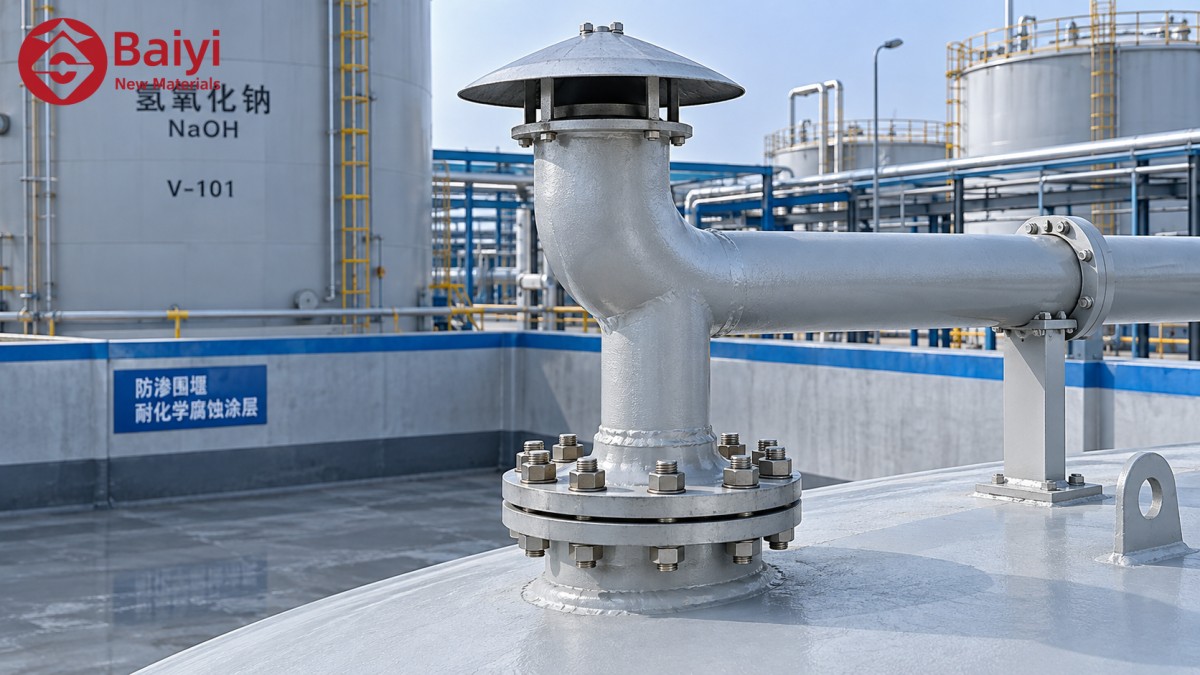
Vent discharge location also matters. Evaluate where mist or entrained liquid could reach personnel, access platforms, nearby equipment, or air intakes. A discharge arrangement that controls exposure must still allow the tank to breathe. Adding a filter, scrubber, or other device introduces resistance and a maintenance requirement that belong in the engineering review.
For quality-sensitive applications, atmospheric exposure can affect carbonate content. Air treatment or a controlled blanketing arrangement may be appropriate, but either requires a pressure and vacuum assessment. Connecting a gas supply to an atmospheric tank without suitable regulation and protective provisions can introduce a new overpressure hazard.
Changes to unloading equipment should therefore trigger a vent review. A faster pump or revised transfer method may exceed the capacity accepted for the original installation. If compressed gas is used anywhere in the delivery process, assess whether gas can enter the receiving tank and how the system prevents pressure from exceeding its limits.
Inspect containment as a working barrier
Secondary containment must hold the release scenario defined for the site and remain chemically resistant long enough for a controlled response. Its adequacy depends on usable capacity, the location of potential leaks, surface integrity, and drainage control. An intact-looking wall provides little protection if a pipe penetration leaks or a drain leads directly away from the area.
Capacity rules vary with jurisdiction, permit conditions, and the installation. Do not assume that a familiar percentage is universally applicable. Determine the governing requirement, then calculate usable capacity after accounting for displacement by tanks and equipment. Outdoor installations also need an appropriate allowance for rainfall and, where required by the site’s assessment, other water entering the area.
Inspect floors, wall joints, sumps, coatings, and penetrations closely. Unprotected concrete should not automatically be accepted as a durable, impermeable barrier for caustic exposure. The concrete system, protective lining where used, joints, and expected exposure conditions need assessment. A chemically resistant coating can still fail through poor adhesion, cracking, mechanical damage, or discontinuities around supports.
Drainage arrangements often determine whether containment works during an incident. Keep drain valves secured in their intended position and control their operation through a documented procedure. Accumulated liquid should be assessed before discharge; rainwater cannot be assumed clean simply because no obvious spill was reported. Provide a safe means of sampling or checking it without requiring personnel to enter contaminated liquid.
Review what else shares the containment area. Acids can react vigorously with caustic and release substantial heat. Other incompatible chemicals or reactive metals may create additional hazards. Shared containment requires a compatibility assessment that considers simultaneous releases and the response method.
Containment around the tank may also leave unloading hoses, pumps, or transfer connections outside the protected area. Inspect the full transfer route and determine where a failed coupling or hose would discharge. Local collection, isolation arrangements, and protected drainage may be needed to address releases beyond the main bund.
Use standards and records to demonstrate fitness for service
There is no single certificate that establishes the safety of every sodium hydroxide storage installation. Compliance evidence normally combines applicable workplace and environmental requirements, a suitable tank design basis, inspection records, and operating controls. The supplier’s safety data sheet supports hazard communication and handling decisions, but it does not replace equipment design calculations or a site-specific assessment.
Standards must be selected within their scope. API 650 addresses welded steel tanks for oil storage and is also used as a design basis for certain other liquid-storage applications where its provisions are suitable; it is not a blanket approval for caustic service. API 653 concerns inspection, repair, alteration, and reconstruction of tanks within its scope. ASTM D1998 addresses polyethylene upright storage tanks. None of these references establishes chemical compatibility for every concentration, temperature, or component.
For a meaningful compliance review, identify the applicable standard, edition, equipment scope, and any supplementary project requirements. A generic statement that a tank is “API compliant” or “chemical resistant” leaves too much unresolved. Retain material specifications, design drawings, relevant fabrication and test records, vent sizing information, and the manufacturer’s operating restrictions.
Inspection records should preserve findings that can be compared over time: measurement locations and results, photographs of defects, repair details, instrument checks, and closure of corrective actions. Internal inspection or tank entry requires its own isolation and entry controls. Do not improvise entry to resolve an uncertain inspection finding.
Turn findings into clear operating decisions
A useful inspection ends with a decision about continued service. Active leakage, serious deformation, a blocked breathing path, or failed containment can require a transfer to be stopped or equipment removed from service, depending on the condition and the site’s response procedure. Less urgent defects still need an owner, a completion date, and any temporary operating restrictions.
Before accepting a delivery, confirm available working capacity, correct transfer routing, vent readiness, containment condition, and the status of level alarms and any installed overfill protection. Personnel should also be able to access the specified protective equipment, emergency washing facilities, and transfer shutdown controls.
Quality control and safety records are most useful when reviewed together. Rising iron levels may support an investigation of corrosion; increasing carbonate may justify examining air exposure; repeated difficulty emptying the tank may point to crystallization or restricted breathing. Each finding needs investigation on its own evidence. The storage system remains acceptable only while its physical condition, operating conditions, and product quality stay within the limits established for service.