



Send Us A Message
How cellulose ethers affect water retention in tile adhesives
A cement-based tile adhesive can spread smoothly yet lose water too quickly on an absorbent substrate or under hot, dry conditions. The resulting moisture loss can restrict cement hydration and reduce tile wetting, weakening bond development. Cellulose ethers improve water retention by thickening the aqueous phase and restricting water movement, but a higher viscosity grade does not automatically deliver better adhesion.
The practical task is to retain enough water for hydration and tile placement without making the mortar difficult to spread or reducing contact beneath the tile. Grade chemistry, dosage, dissolution behavior, and the complete formulation determine that balance.
Water retention inside a thin adhesive bed
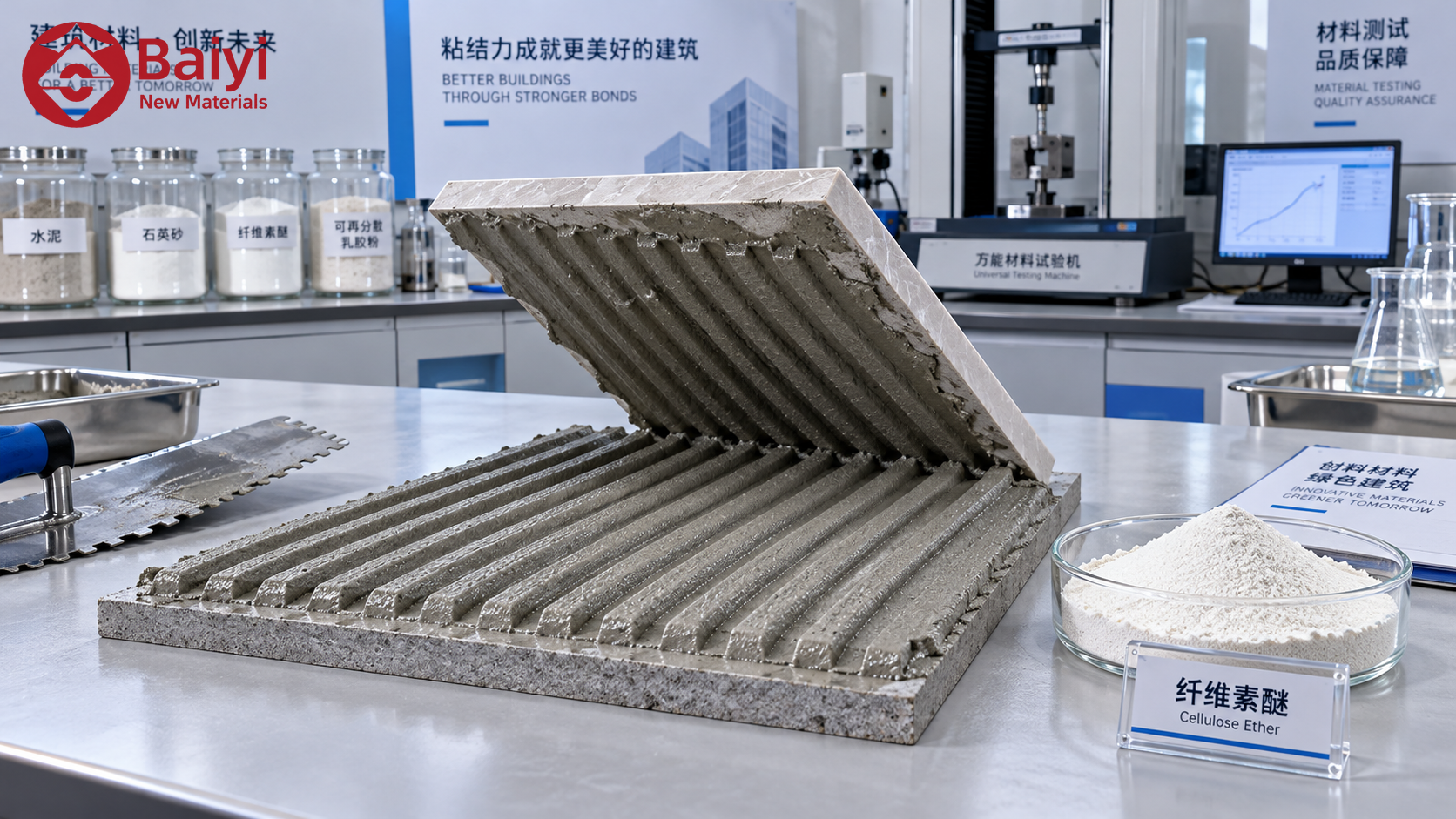
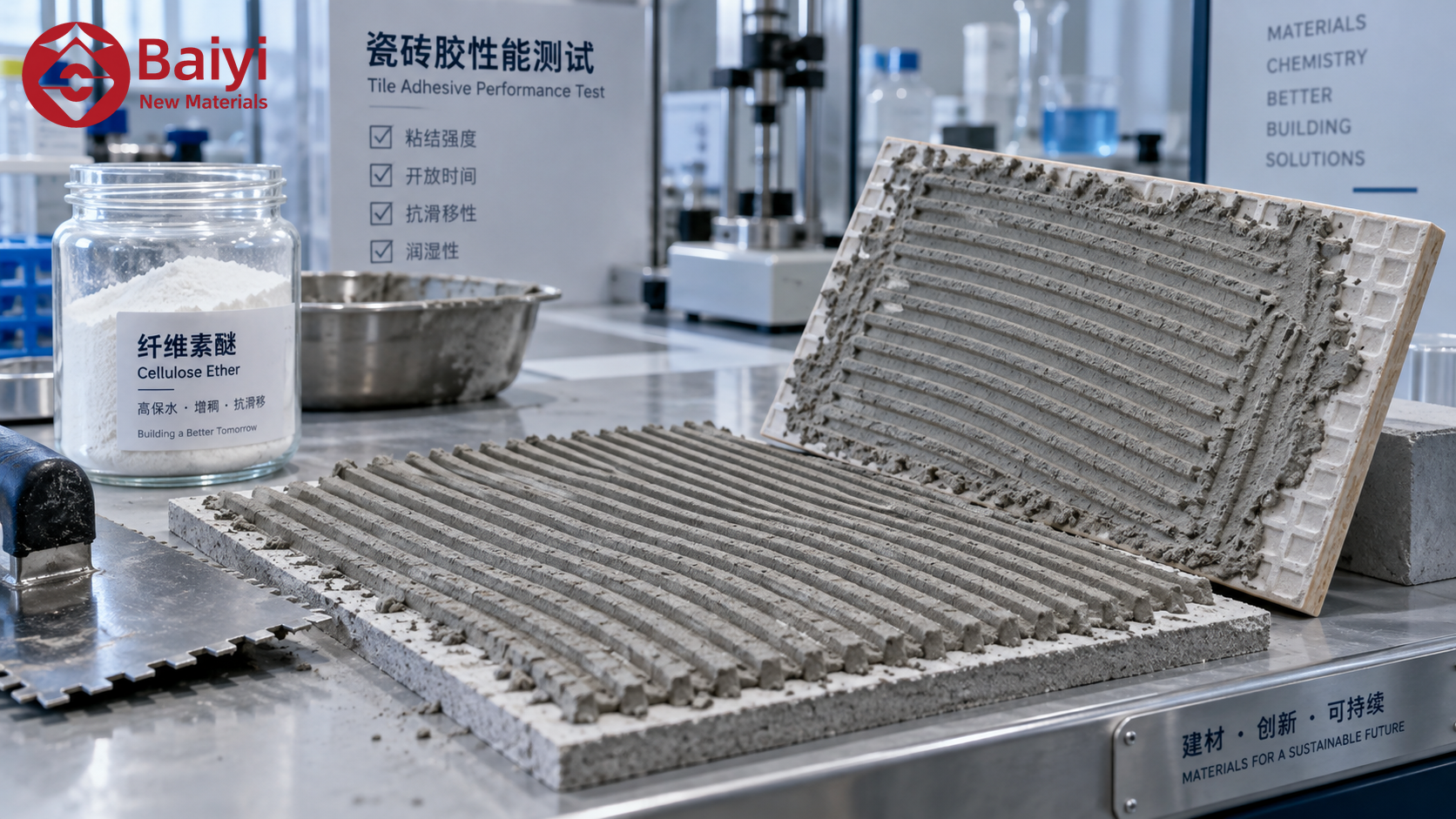
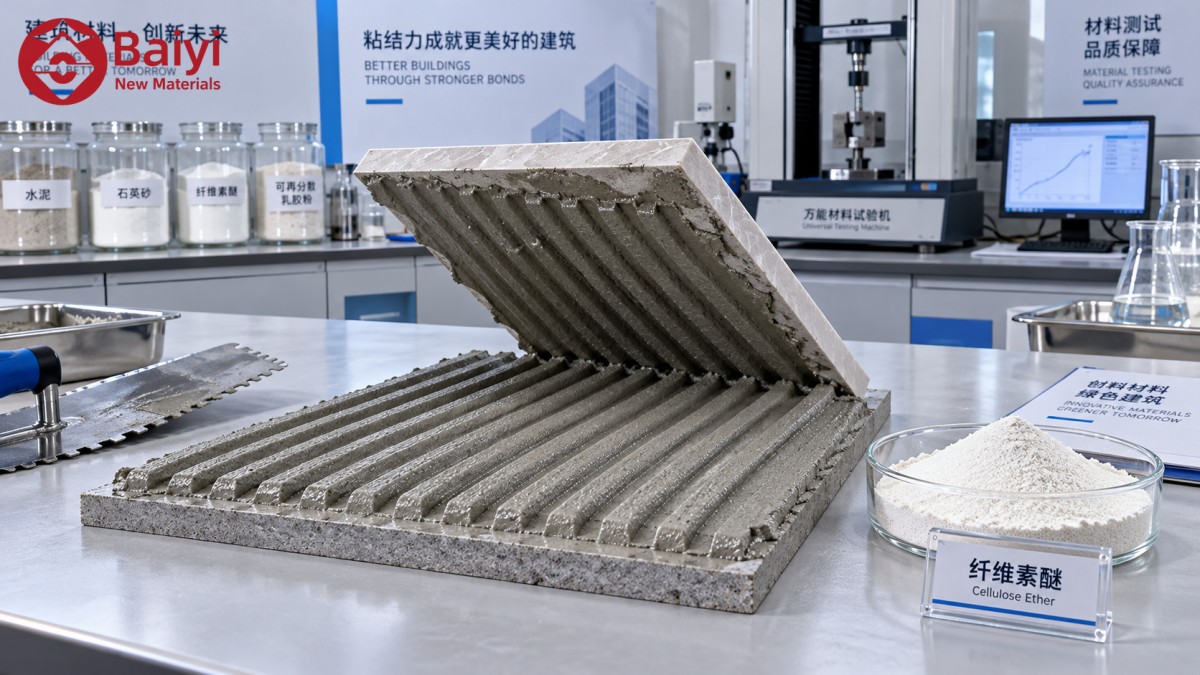
After application, water can leave the adhesive through substrate suction and surface evaporation. A thin, combed bed is particularly exposed because its ridges have a large surface area relative to their volume. Rapid drying can produce a surface skin while the material underneath still feels workable.
Common cellulose ethers used in these adhesives include hydroxypropyl methylcellulose (HPMC) and hydroxyethyl methylcellulose (HEMC). Once dissolved, their polymer chains increase aqueous-phase viscosity and resistance to water transport through the mortar. Their interaction with the pore solution and solid particles also affects rheology and moisture distribution. This slows water loss; it does not make the adhesive immune to drying.
Water retention and open time are related, but they are not interchangeable. Water retention describes resistance to water removal under defined conditions. Open time concerns how long after spreading a tile can be placed while still achieving the required bond performance. Surface skinning, wetting, and placement pressure influence the latter even when bulk moisture remains adequate.
Why viscosity alone is an incomplete selection criterion
A supplier’s viscosity value normally describes an aqueous solution tested at a specified concentration, temperature, and measurement method. It is not a direct measurement of water retention in cement mortar. Compare viscosity figures only when those conditions are equivalent.
- Molecular weight and viscosity grade: Increasing molecular weight often raises solution viscosity and can improve retention, but the benefit may level off while spreading resistance continues to increase.
- Substitution chemistry: The type, level, and distribution of substituent groups influence solubility, thermal behavior, and interactions with the cementitious system. Similar nominal viscosities can therefore produce different application behavior.
- Dosage and dissolution: Insufficient dosage may leave retention inadequate. Poor dispersion or incomplete dissolution can produce inconsistent thickening, even when the weighed addition is correct.
- Formulation compatibility: Cement composition, aggregate grading, fine-particle content, redispersible polymer powder, and other additives can change water demand, air content, and rheology.
More additive is not always the corrective action. Excessive thickening can impair ridge collapse and tile wetting. Depending on the grade and formulation, increased cellulose ether content may also influence air entrainment and delay hydration or setting. These effects can offset the benefit of improved moisture retention.
Distinguish moisture loss from poor contact
When tiles show limited adhesive transfer after a placement delay, first examine the exposed ridge surface. A dry skin points toward rapid surface drying, but poor transfer can also result from an overly stiff mortar, insufficient placement pressure, or unsuitable troweling. Touch alone cannot establish whether the remaining bed will develop adequate adhesion.
A comparison protocol that separates additive effects
- Establish a controlled baseline. Keep cement, aggregates, other additives, mixing procedure, maturation time, and specimen preparation unchanged. Record room conditions and substrate characteristics.
- Run a fixed-water comparison. Change only the cellulose ether grade or dosage. Measure consistency alongside retention so that a stiffer mix is not mistaken for an unqualified improvement.
- Evaluate practical workability separately. If water is adjusted to achieve comparable application consistency, document that adjustment. Added water changes porosity and strength development, so these results answer a different question from fixed-water trials.
- Measure both retention and adhesive performance. Use a defined retention procedure, then evaluate open time through delayed tile placement and subsequent tensile adhesion testing. Include the conditioning relevant to the intended classification.
For a retention test, report the water-removal method, contact duration, temperature, and calculation basis. Results obtained using different suction arrangements or procedures should not be treated as directly interchangeable.
For standards-based evaluation, EN 12004-1 defines requirements and classification for ceramic tile adhesives, while EN 12004-2 covers test methods. Verify the applicable edition and project specification before setting acceptance criteria. A standalone water-retention result does not establish an adhesive classification.
Select the grade and dosage that preserve delayed-placement adhesion and adequate tile contact under the intended conditions, not simply the combination with the highest measured retention. Where retention improves but bond performance declines, investigate air content, setting behavior, water demand, and contact formation before increasing the dosage further.