



Send Us A Message
Buying Cellulose Ethers for Tile Adhesives: Key Grade Selection Criteria
The right cellulose ether for a cement-based tile adhesive is the grade that delivers the required application and bond performance at a controlled formulation cost—not the grade with the highest viscosity or the lowest price per kilogram. Two products carrying similar viscosity specifications can produce different water demand, troweling resistance, slip resistance, and open time.
A sound selection therefore requires two levels of evidence: comparable raw-material specifications and performance tests in the intended adhesive formulation. HPMC and HEMC labels help identify the chemistry, but neither the polymer family nor a single certificate-of-analysis value establishes whether a grade is suitable.
Define the adhesive requirements before comparing grades
A meaningful request for quotation starts with the application, not a viscosity number. A thin-bed adhesive for absorbent ceramic tiles does not present the same demands as an adhesive for low-absorption porcelain, large-format tiles, or installation on a hot, absorbent substrate.
The selection brief should identify the cement and filler system, redispersible polymer powder, other functional additives, intended mixing-water range, application thickness, and required adhesive classification. Site conditions also matter: elevated temperature, airflow, and substrate suction can accelerate water loss and expose weaknesses that are not apparent under controlled laboratory conditions.
Distinguish the performance terms carefully. Open time concerns the interval after spreading during which the adhesive can still develop the required bond when a tile is embedded. Pot life concerns usability after mixing. Adjustment time concerns repositioning after placement. A grade described as providing “long working time” is not sufficiently specified unless the supplier identifies which property was measured and how.
For adhesives assessed under EN 12004, classification belongs to the finished adhesive, not to the cellulose ether. Relevant EN 12004-2 test methods or applicable ISO 13007 methods can provide an agreed evaluation basis. A raw-material supplier’s description of a grade as suitable for a particular adhesive class is an application recommendation, not proof that a formulation meets that class.
HPMC or HEMC: compare the grade, not just the family
Hydroxypropyl methylcellulose (HPMC) and hydroxyethyl methylcellulose (HEMC, also called MHEC) are both used in cementitious tile adhesives. Their substitution chemistry influences hydration, solution behavior, thermal response, and interaction with the mortar system. Molecular weight, substitution distribution, particle characteristics, and any additional modification also affect performance.
HEMC grades are often considered when temperature robustness is important, while HPMC grades also cover a broad range of tile-adhesive applications. However, family-level comparisons cannot establish a universal winner. A well-matched HPMC grade can outperform an unsuitable HEMC grade in a specific formulation, and vice versa.
Ask whether the proposed material is an unmodified cellulose ether or a modified grade containing other functional components. Modification can improve particular properties, but it can also make replacement less straightforward. Full proprietary composition may not be available; nevertheless, the supplier should identify the product’s intended function, relevant compatibility limits, and whether changes to its modification package trigger customer notification.
Why viscosity numbers can mislead
Viscosity is useful for screening and quality control only when the test conditions are known. A quoted value without its measurement method is not a dependable basis for comparing suppliers.
Even a valid, like-for-like solution-viscosity comparison does not predict all mortar properties. Tile adhesive contains cement, mineral particles, dissolved ions, polymers, and entrained air. Its response under mixing, troweling, and resting differs from that of a cellulose ether solution.
Higher viscosity can increase body and help resist tile movement, but excessive thickening can increase troweling drag, restrict wetting, and make ridge collapse more difficult. The correct endpoint is a workable adhesive that transfers adequately to the tile—not maximum thickness in the mixing bucket.
Evaluate water retention together with wetting and open time
Cellulose ethers help limit water loss from fresh adhesive, supporting cement hydration and maintaining usable consistency. This becomes particularly important when the substrate draws water rapidly or exposed adhesive dries before tile placement.
However, a high water-retention result does not independently establish good open time or bond strength. Open-time performance also depends on surface skin formation, tile wetting, water content, polymer modification, and exposure conditions. A formulation can retain water within its bulk while developing a surface that no longer wets the tile effectively.
Request the water-retention method, substrate or filter arrangement, test duration, temperature, and formulation. Percentages generated by different procedures should not be ranked as if they were interchangeable. Where hot-weather application is important, test the complete adhesive under defined elevated-temperature conditions rather than relying solely on room-temperature data or the cellulose ether’s thermal gelation specification.
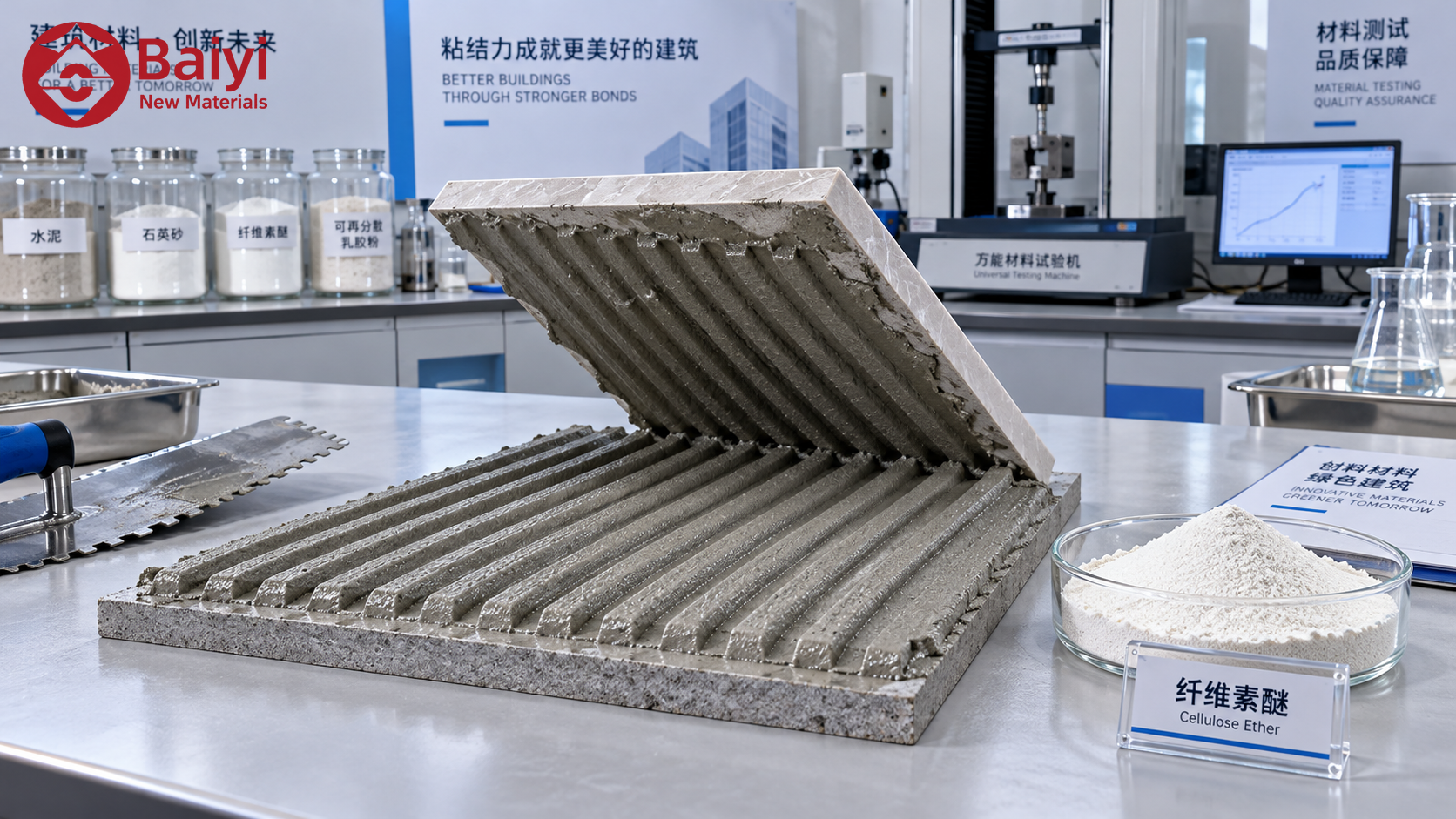
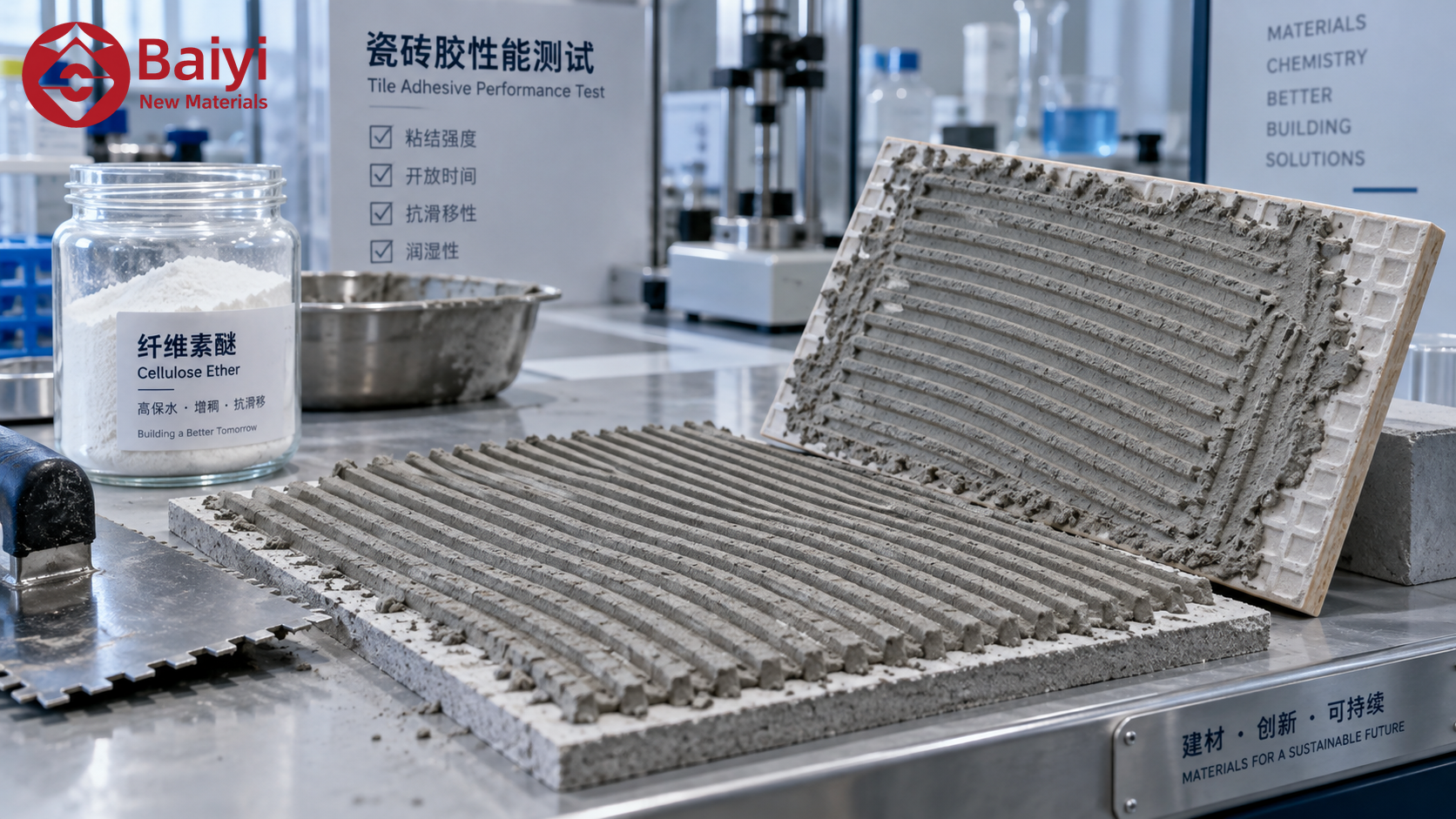
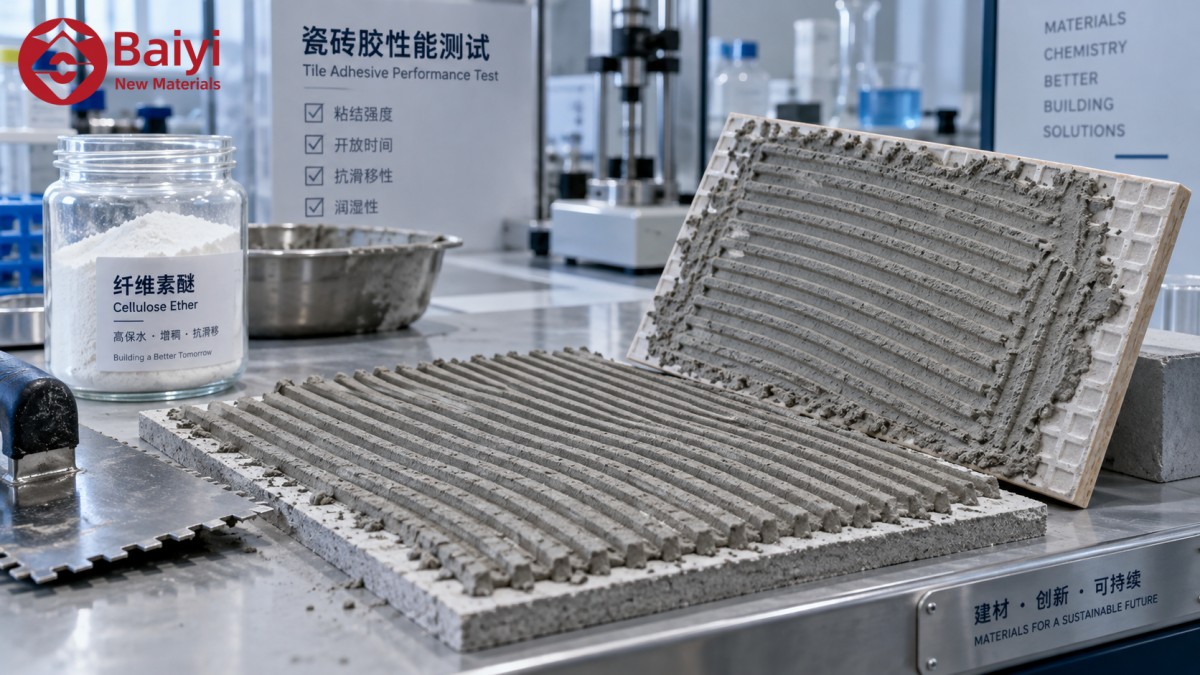
Tile lift checks can help reveal transfer and ridge collapse during development, but they do not replace standardized adhesion testing. Their value is diagnostic: they can help explain why a mortar that feels workable fails to deliver acceptable bonding after a delay.
Check the balance between slip resistance and application effort
For wall applications, the adhesive must resist downward tile movement without becoming unnecessarily difficult to spread. This balance depends on the mortar’s structure at rest and its response under shear, not simply on solution viscosity.
Evaluate troweling effort, ridge stability, slip, tile embedding, and adjustment together. A grade that reduces slip but requires excessive force to embed tiles may create a different installation problem. Likewise, increasing mixing water to improve workability can change slip, air content, and hardened performance.
Other additives complicate attribution. Starch ethers, mineral rheology modifiers, and redispersible polymer powders can alter the same properties influenced by cellulose ether. When comparing candidates, keep these ingredients fixed initially. Otherwise, improvements caused by a broader formulation change may be incorrectly credited to the replacement grade.
Air content deserves particular attention. Cellulose ether grade and formulation interactions can affect air entrainment and fresh density. Easier spreading alone is not evidence of superior performance; check whether the change is accompanied by a density shift or reduced adhesion.
Dissolution behavior must match actual mixing conditions
A grade that performs well after extended laboratory mixing may behave differently when mixed on site with less time, variable water temperature, or lower mixing energy. Poor dispersion or delayed hydration can cause lumps, changing consistency, and uneven application.
Particle-size distribution and surface treatment influence dispersion and viscosity development. Fine material can hydrate rapidly but may agglomerate if dispersion is inadequate. Surface-treated grades can delay hydration to facilitate dispersion, although their response depends on treatment chemistry and mixing conditions; the alkaline cement environment can alter that response.
Test the product in the intended dry blend and with the specified water-addition sequence, mixing time, maturation period, and remixing procedure. Record consistency immediately after mixing and after the prescribed standing period. A large increase in stiffness can lead users to add extra water, undermining the formulation’s validated operating range.
Compatibility checks should use the intended cement and representative mineral raw materials. Cement chemistry, fine-particle content, and impurities can alter additive response. Qualification in an unrelated reference mortar is useful for screening, but insufficient for approving a production substitution.
Build a trial that separates substitution from optimization
A controlled evaluation should begin with the existing approved grade as the reference. Use the same raw-material lots, equipment, conditioning, and testing procedures wherever practical.
Run an equal-dose comparison first. Keep cellulose ether dosage and mixing water constant to expose differences in dispersion, consistency, fresh density, slip, and water retention. This identifies the immediate consequences of a direct substitution.
Then evaluate an optimized formulation. Adjust water and, where justified, dosage to reach the intended application consistency. Record every adjustment and repeat the relevant performance tests. This second comparison establishes whether a candidate is commercially attractive when properly formulated, rather than merely whether it copies the incumbent at identical settings.
The test program should include open-time adhesion and the conditioning regimes required by the intended adhesive specification, such as water immersion or heat aging where applicable. Also monitor setting behavior: a change in cellulose ether grade or dosage can influence cement hydration, and acceptable fresh properties do not guarantee acceptable strength development.
A single successful sample is weak evidence of supply consistency. Qualification should include more than one production batch, with the extent of testing proportionate to the consequences of failure. Retained samples and recorded batch identifiers make later investigations considerably more useful.
Turn supplier documentation into enforceable controls
The technical data sheet describes the product; the certificate of analysis records selected batch results. Neither is sufficient unless the approved purchasing specification defines the relevant methods, limits, and grade identity.
Useful controls include viscosity, moisture, particle size or sieve residue, and other parameters shown to affect the formulation. Ash or inorganic residue can help characterize consistency, but should not be treated as a stand-alone purity ranking without understanding the test method and product composition.
Separate routine release tests from application tests. It may be impractical to run a complete adhesive performance program for every shipment. A defensible arrangement combines agreed batch-release parameters with periodic application verification and additional testing after significant changes.
Supply qualification should also establish:
- Manufacturing-site identification and batch traceability, including materials supplied through distributors.
- Notification requirements for changes to production site, process, raw-material sourcing, or grade modification.
- Moisture-resistant packaging, storage conditions, shelf life, and treatment of damaged bags.
- Lead times, shipment documentation, and realistic continuity arrangements.
- Current safety data and destination-specific chemical compliance documentation where applicable.
A quality-management certificate can support supplier assessment, but it does not demonstrate suitability for a particular adhesive. Likewise, a replacement offered under an “equivalent” grade designation should remain subject to technical approval.
Compare cost at the validated formulation level
Price per kilogram is only one part of the calculation. The direct cellulose ether cost per tonne of adhesive equals its delivered price per kilogram multiplied by the validated dosage in kilograms per tonne. The comparison should then include any necessary changes to other additives and the costs of qualification, logistics, and inventory.
A lower-priced grade can lose its advantage if it requires a higher dosage or additional rheology correction. A higher-priced grade is not automatically economical because a supplier recommends using less; the reduced dosage must preserve open time, slip resistance, workability, and required adhesion performance.
The purchase specification should therefore identify the approved grade, its control limits, and the formulation conditions under which it was qualified. Any alternative should be assessed against the same performance requirements. This keeps sourcing flexibility tied to demonstrated adhesive performance rather than an assumed equivalence between product names or viscosity values.