



Send Us A Message
How to prevent titanium dioxide agglomeration in water-based paints
How to prevent titanium dioxide agglomeration in water-based paints
Is your water-based paint losing hiding power or showing visible specks despite thorough mixing? Titanium Dioxide agglomeration can reduce opacity, disrupt gloss, and make batch consistency harder to control. Increasing mixer speed is not always the answer. Reliable dispersion depends on wetting the pigment, breaking down loose agglomerates, and keeping the separated particles from coming back together.
The useful question is not simply “How long did we mix?” It is “At which stage did the dispersion stop behaving as expected?” A rough grind and a smooth grind that flocculates during letdown require different corrections.
Check whether the problem starts in the grind or the letdown
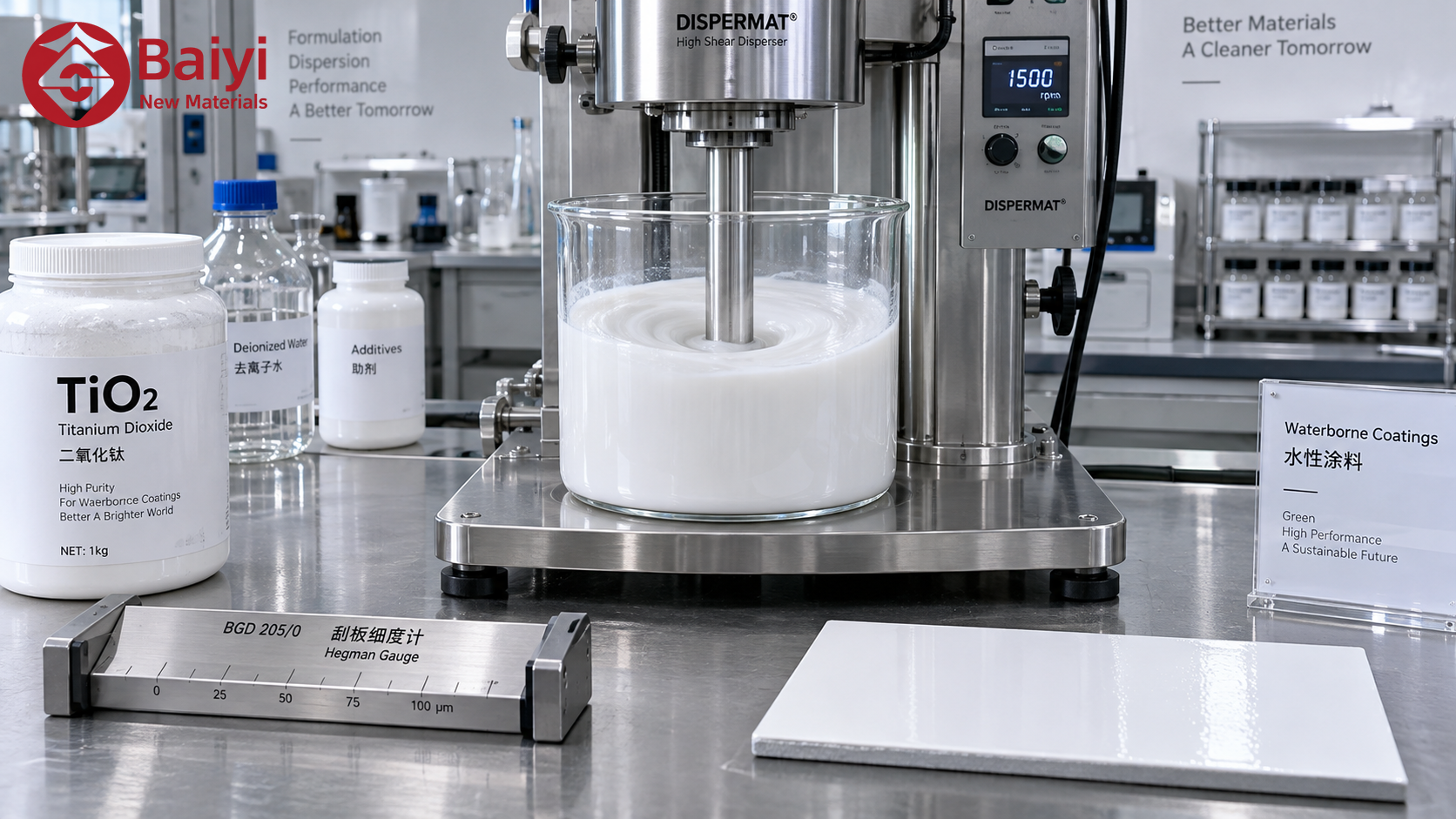
Take samples immediately after pigment dispersion, after binder addition, and after storage. Use a grind gauge to check for coarse particles, then compare drawdowns at the same film thickness and drying conditions. A grind gauge helps detect coarse material, but it does not prove that the pigment is optimally dispersed for opacity.
If the grind is already coarse, investigate powder incorporation, dispersant selection, and shear conditions. If it looks acceptable before letdown but deteriorates afterward, check binder compatibility, pH changes, and the addition sequence. Visible specks can also be dried paint, contamination, or coagulated binder—not necessarily pigment agglomerates.
Match the pigment surface and dispersant—not just the product names
Choose a titanium dioxide grade recommended for your waterborne coating system. Surface treatments influence wetting, dispersant demand, and compatibility. Two rutile grades with similar headline specifications may not behave identically in the same grind formulation.
A wetting agent helps water contact the powder; a dispersant helps stabilize the separated particles. Some additives perform both functions, but they are not automatically interchangeable. Select them against the pigment supplier’s guidance and the complete formulation, including extenders.
Run a small dispersant-demand series rather than adding more whenever viscosity rises. Keep pigment loading and processing conditions constant, calculate dosage on an active-content basis, and compare viscosity, grind quality, drawdowns, and storage stability. The lowest initial viscosity is a useful clue—not the only acceptance criterion. Excess additive can introduce foam or compromise film properties.
Control powder addition and the actual mixing conditions
For a conventional pigment-grind process, a practical starting sequence is:
- Charge the specified grind water, dispersant, and other grind-stage additives. Adjust pH as required by the formulation.
- Establish circulation, then feed pigment steadily into moving liquid. Avoid dumping bags faster than the mixer can incorporate them.
- After wet-out, apply the validated dispersion conditions while monitoring temperature, viscosity, and grind quality.
- Proceed to binder letdown under controlled agitation, following the binder supplier’s addition guidance.
Follow site dust-control procedures during powder charging. A floating powder raft or persistent dry pockets usually indicate an incorporation problem; extending the final mixing time may not fix it efficiently.
Watch the flow around the disperser blade. A thin slurry may circulate without receiving enough effective shear, while an overly thick grind can develop stagnant zones. Blade diameter, vessel geometry, fill level, and grind viscosity matter alongside rotational speed. Copying laboratory rpm directly to a production tank is not a dependable scale-up method.
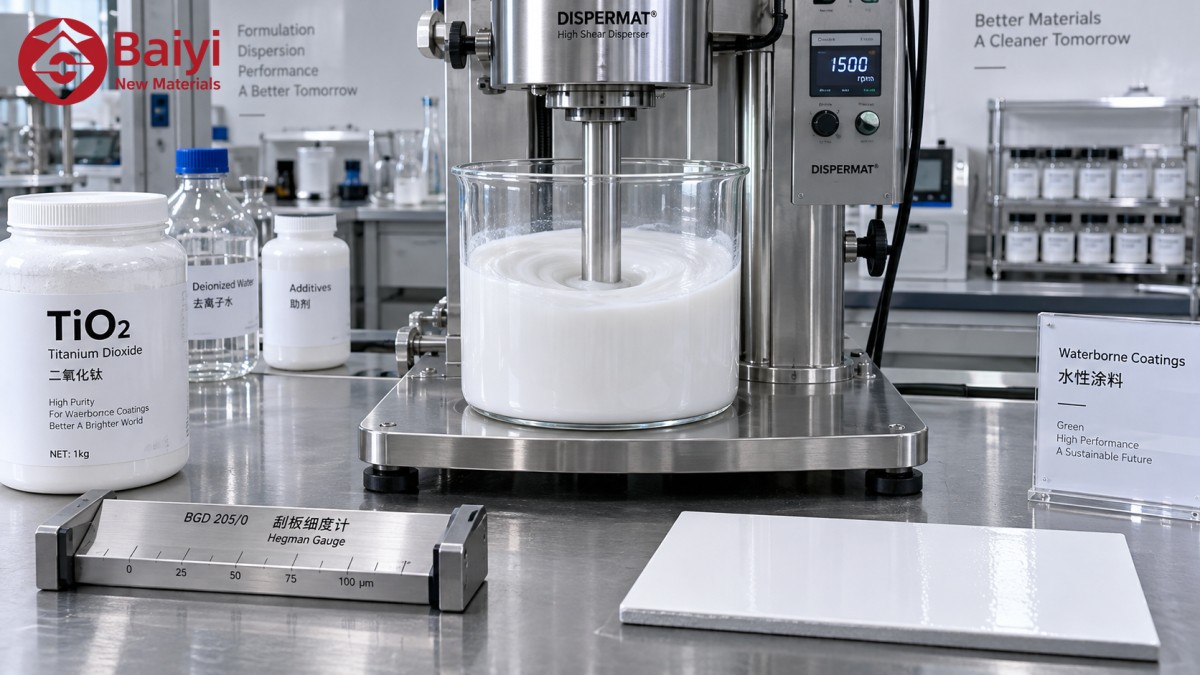
Do not keep adding energy once grind quality has stopped improving. Rising temperature and entrained air can create new problems. Check formulation and equipment conditions before deciding that the batch needs longer processing or a different dispersion machine.
Protect the dispersion through letdown and storage
There is no universal pH target for every water-based paint. Use the operating window recommended for the binder, pigment, and dispersant combination, and measure it after letdown as well as during the grind. Uncontrolled pH adjustment can destabilize an otherwise acceptable batch.
Water quality also deserves attention. Changes in hardness or dissolved salts can affect some dispersant systems. If a previously stable formula starts drifting, compare production water and raw-material lots before redesigning the additive package. Remember that settling alone does not prove agglomeration; inadequate suspension control can also allow well-dispersed pigment to settle.
For raw-material discussions with Shandong Carbon Steel Metal Products Co., Ltd., founded in 2008 and supplying chemical raw materials, surfactants, polymers, and additives internationally, share the pigment grade, binder chemistry, addition sequence, and the stage where failure appears. These details make technical support more useful than a request for a generic dispersant.
Before changing the production recipe, confirm the proposed correction in a controlled trial and retain samples for storage checks. Accept the change only when easier processing is matched by consistent hiding power, appearance, and stability—not merely a smoother-looking tank.