



Send Us A Message
How to select polyethylene for stress-crack-resistant bottles
A bottle can pass dimensional checks and drop tests, then develop a fine crack after weeks in storage. Surfactants, molded-in stress, closure loads, and temperature can expose weaknesses that routine inspection misses. Selecting polyethylene for stress-crack-resistant bottles therefore means balancing environmental stress crack resistance (ESCR), stiffness, processing behavior, and compatibility with the actual contents—not simply choosing a density or melt flow rate.
Define the exposure before comparing polyethylene grades
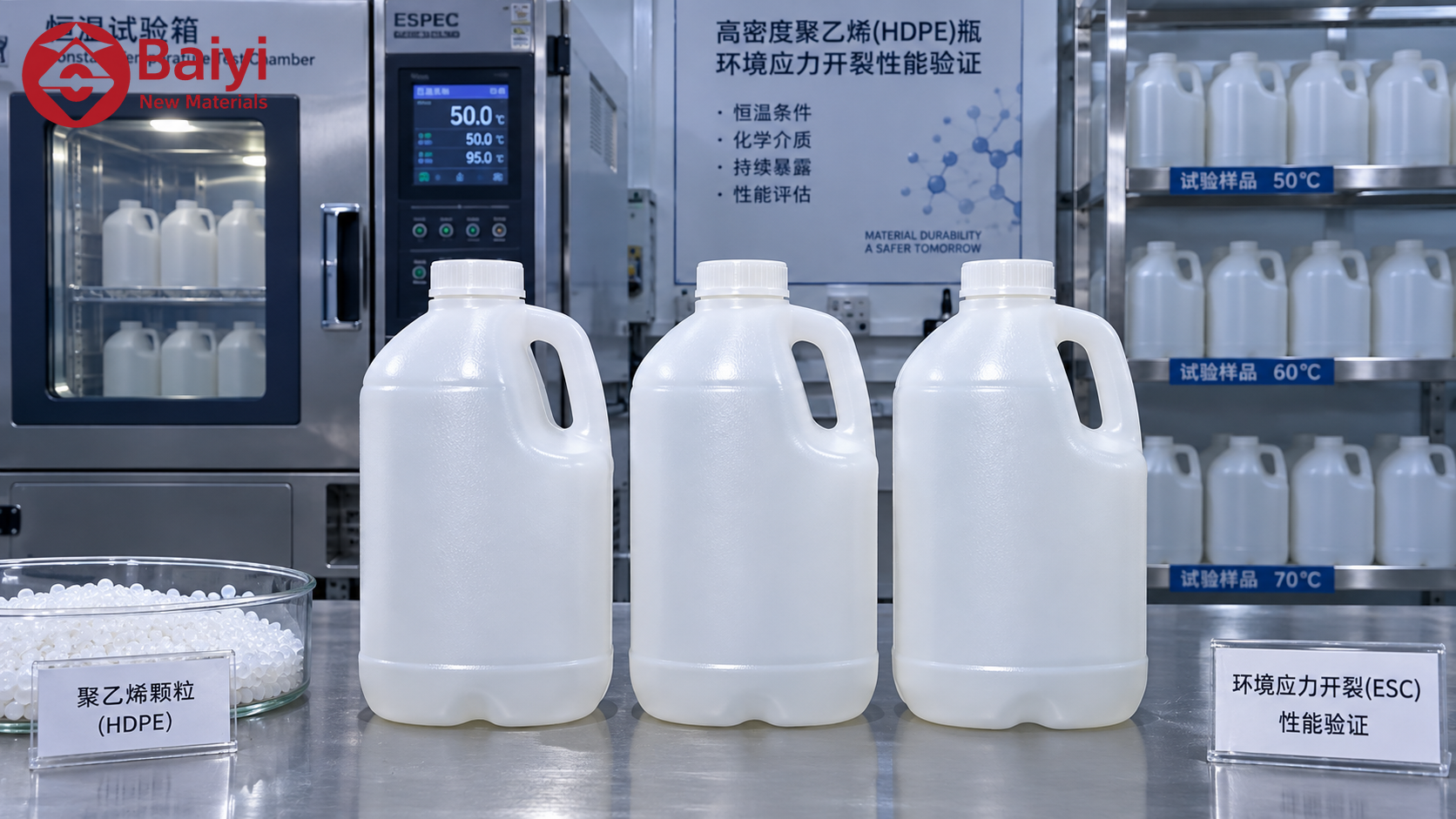
Environmental stress cracking occurs when tensile stress and an aggressive environment act together. A liquid does not need to dissolve polyethylene to promote cracking. Detergents and other surfactant-containing formulations can accelerate failure at stressed locations such as the handle root, shoulder, pinch-off, or neck.
Before requesting resin recommendations, prepare an application brief covering:
- Contents: complete formulation, concentration ranges, and possible changes in surfactants, solvents, fragrances, or other additives.
- Service conditions: filling temperature, storage duration, temperature excursions, stacking loads, and transport conditions.
- Bottle design: capacity, target weight, wall distribution, handle geometry, and closure torque.
- Manufacturing constraints: blow-molding equipment, output expectations, and intended regrind or recycled-content level.
This brief prevents a common purchasing mistake: comparing resin grades that were developed for different bottle duties.
Read the resin specification as a set of trade-offs
Blow-molding-grade high-density polyethylene (HDPE) is a common starting point because it combines rigidity, chemical resistance, and processability. However, two HDPE grades with similar density and melt flow rate can deliver substantially different ESCR.
A lower-flow grade may offer useful melt strength and crack resistance, but it can also change extrusion pressure, energy demand, and surface quality. Likewise, selecting a softer material to gain ESCR may require a bottle redesign to retain top-load performance. Evaluate these consequences together rather than optimizing one data-sheet number.
Do the ESCR figures actually match?
A result reported as “more than a specified number of hours” is not a universal service-life prediction. ASTM D1693, for example, evaluates bent specimens under specified conditions; it does not reproduce every stress pattern in a blow-molded bottle.
When reviewing supplier data, request the test condition, specimen preparation and thickness, reagent identity and concentration, temperature, and endpoint. An F50 value represents the time associated with 50% specimen failure—not a guaranteed minimum life for every bottle. A test stopped without failures should also be distinguished from a measured failure time.
Use laboratory ESCR to shortlist candidates, not to approve the package. Rankings from different methods or exposure conditions should not be treated as directly interchangeable. Accelerated testing is valuable, but translating hours at elevated temperature into shelf life requires validation.
Let finished bottles make the final decision
Run shortlisted resins on the intended production equipment. Record melt temperature, parison settings, cooling conditions, bottle weight, and wall-thickness distribution. A strong resin cannot fully compensate for a thin shoulder, sharp transition, or inconsistent pinch-off.
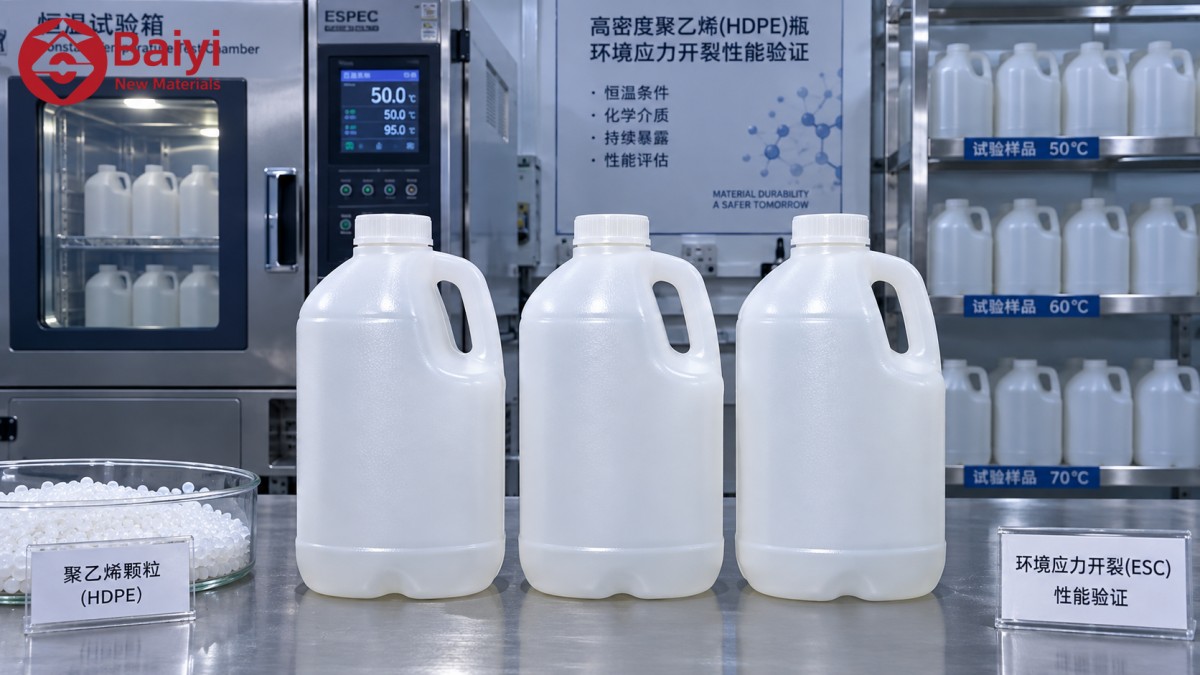
Fill trial bottles with the actual formulation, apply the intended closure and torque, and expose them to relevant storage and mechanical loads. Include the handle, neck, base corners, and weld regions in inspections. Testing several bottles and production runs gives a more useful picture than relying on one successful sample.
Assess leakage and cracking alongside drop resistance, top load, dimensional stability, and closure performance. Where applicable, ASTM D2561 provides an approach for evaluating environmental stress-crack resistance of blow-molded polyethylene containers. Select the procedure and acceptance criteria to match the package and customer requirements.
If regrind or post-consumer recycled material is planned, validate the intended blend separately. Processing history, contamination, and feedstock variability can alter performance. Approval of virgin resin alone does not establish the suitability of the production blend.
Build a purchasing specification that protects the result
Once a candidate passes, document the exact grade, agreed property limits, traceability requirements, and notification expectations for material changes. Keep an approved reference sample and define when formulation, bottle design, or processing changes trigger requalification.
For discussions with Shandong Carbon Steel Metal Products Co., Ltd., an application brief and a clear test protocol provide a practical basis for evaluating polyethylene supply options within its polymers and chemical raw materials business. Ask for grade-specific technical documentation and sample availability rather than relying on a general material description.
The best choice is the polyethylene that demonstrates adequate crack resistance in your filled bottle while meeting production and structural requirements. That evidence is more valuable than the highest ESCR figure on an otherwise incomplete data sheet.